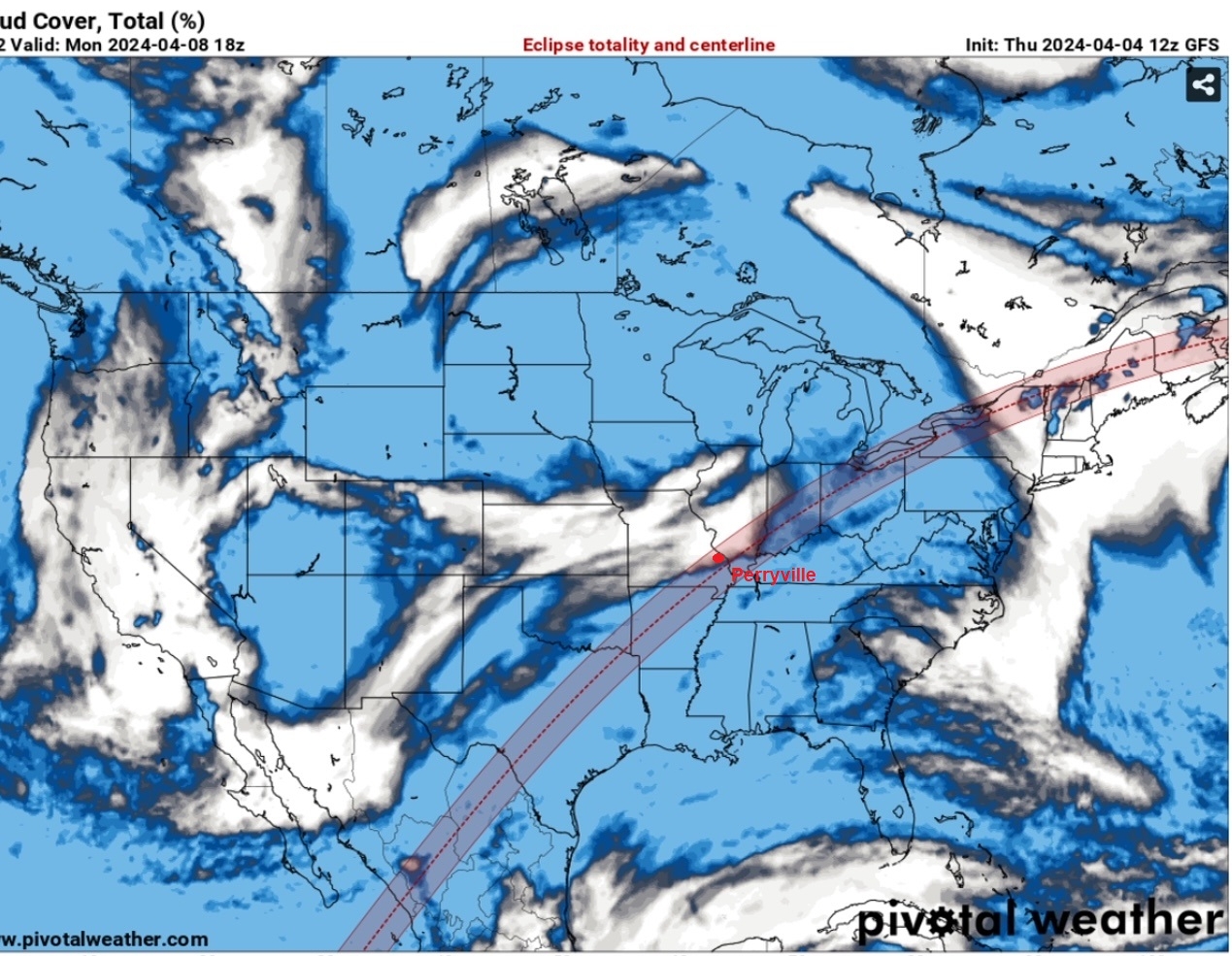
Solar Eclipse - Missouri April 8, 2024
The US forever stamp for the 2017 eclipse
After the 2017 nuclear power plant issue, I wanted to make sure I had a good site for the eclipse where I did not have to deal with a traffic jam after the eclipse. The eclipse path would go from Texas, through the midwest, and exit the United States through upper New England in Maine. One would think I would simply plan on observing from NH. I chose not to because the duration was shorter (about 3 minutes and 30 seconds) and my familiarity with New England indicated the chance for clear skies at that time of year was going to be poor. A year before the eclipse, I began to look for a hotel location in the Texas region along the line of totality. Texas was predicted to have the best chance for clear skies and a longer duration of totality, which is why I focused my attention there. I could not locate any hotels near the centerline. However, I managed to find a springs resort, in Leakey, Texas, that offered cabins for rent. It looked like a perfect location. My wife and I would have a cabin that would allow us to set up early and then rest after the end of the eclipse. It was also near the centerline and would have a totality time of 4 minutes and 25 seconds. To top it off the location seemed to have dark skies with a bortle scale of 3-4, which would allow for some astrophotography in the evening. It seemed like it would be perfect for the eclipse. I planned on arriving on Friday (April 5) and then leaving on Tuesday (April 9th).
Eclipse day approaches
The trip to Texas would take about five days. When packing the car, I took great effort to make sure I packed everything I could. My wife would later be surprised how much was actually in the vehicle. We left in late March and stopped in Knoxville, Tennessee for a few days to visit our son and his family. That part of the trip went well. However, while we were there, I began to focus my attention on the long range weather forecasts. A disturbing picture began to emerge. The weather was not looking good for Texas. Pivotal weather was indicating that it was going to be cloudy in Leakey. I thought that we could still go to Texas and travel on eclipse day to clear skies. However, things were not looking that good for any location in Texas. The long range prediction had the best opportunity for clear/mostly clear skies was in Missouri. The day before we left Knoxville, I looked for hotels in Missouri and found one in Perryville, which had a totality duration of 3 minutes and 47 seconds. It wasn't Texas but, with the best chance of clear skies, I was not going to be picky. The cost of the room for one night was expensive but I still made the reservation. It was my intention to make a decision when we reached Arkansas that night. This was the weather prediction for the morning of the fourth of April and it was clear that Leaky, Texas was a non-starter. I had to bite the bullet on the money for the springs cabin since I could not get a refund that late. This, along with the hotel room in Perryville was going to make the eclipse trip expensive but money was not an object at this point.
This brought up what we were going to do on the weekend. My wife decided it would be fun to visit New Orleans. So, we drove to New Orleans on Friday and did some sightseeing on Friday and Saturday. We then left Sunday morning and drove to Perryville. The trip from New Orleans to Perryville was long and we drove through thunderstorms in Arkansas in southern Missouri. However, when we reached Perryville, the sky was clear as predicted!
I arose early that morning to setup the equipment and polar align the scopes before sunrise. By the time the sun was rising, I was almost set up. My wife was shocked to see this when she came out to see how things were going.
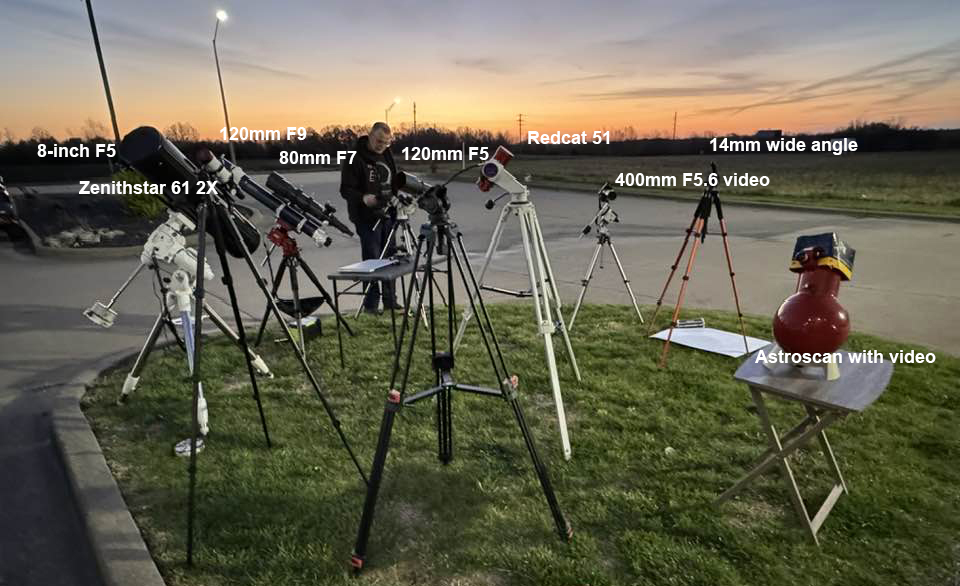
Yes, I probably over did it on bringing my gear. However, I did not want to have the failures I had in 2017. Several cameras were operated by computer and others were operated manually or through an intervalometer. Not visible in this image was the instrument my wife operated a Hestia with an I-phone. This was an afocal setup that was designed for imaging the sun with a cell phone.
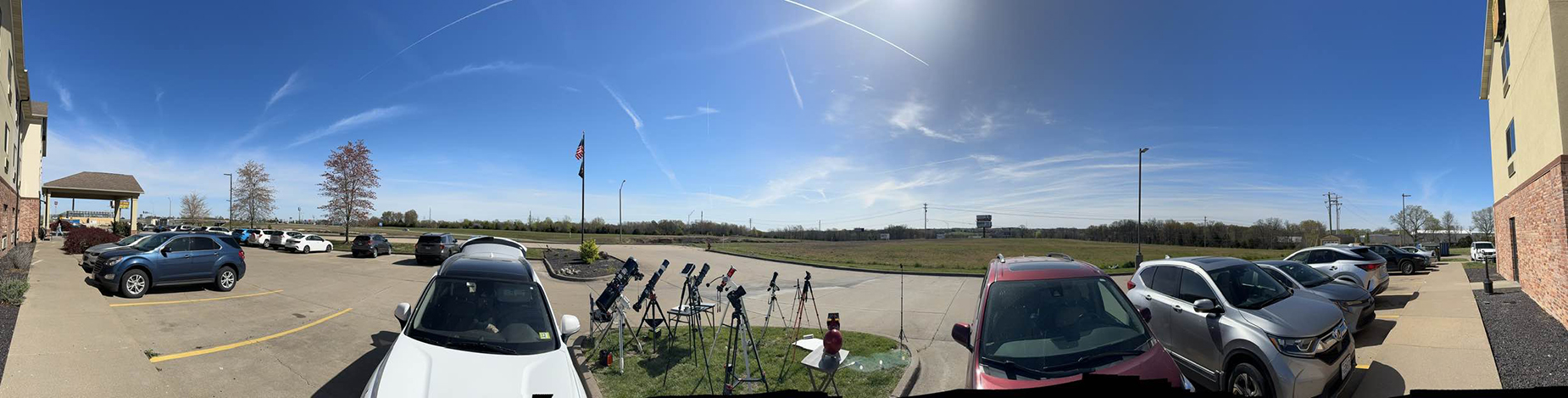
Guests, who saw the setup were very interested. They agreed with my wife that it was overkill it but I explained I wanted to make sure that I got the shots I desired. We had quite the gathering in the parking lot as people gathered to see the eclipse. Many got a chance to look through the astroscan, which I had setup visually prior to totality to observe the partial phases. I switched to the electronic eyepiece about ten minutes prior to totality so I could videotape the beginning of totality.
Totality!
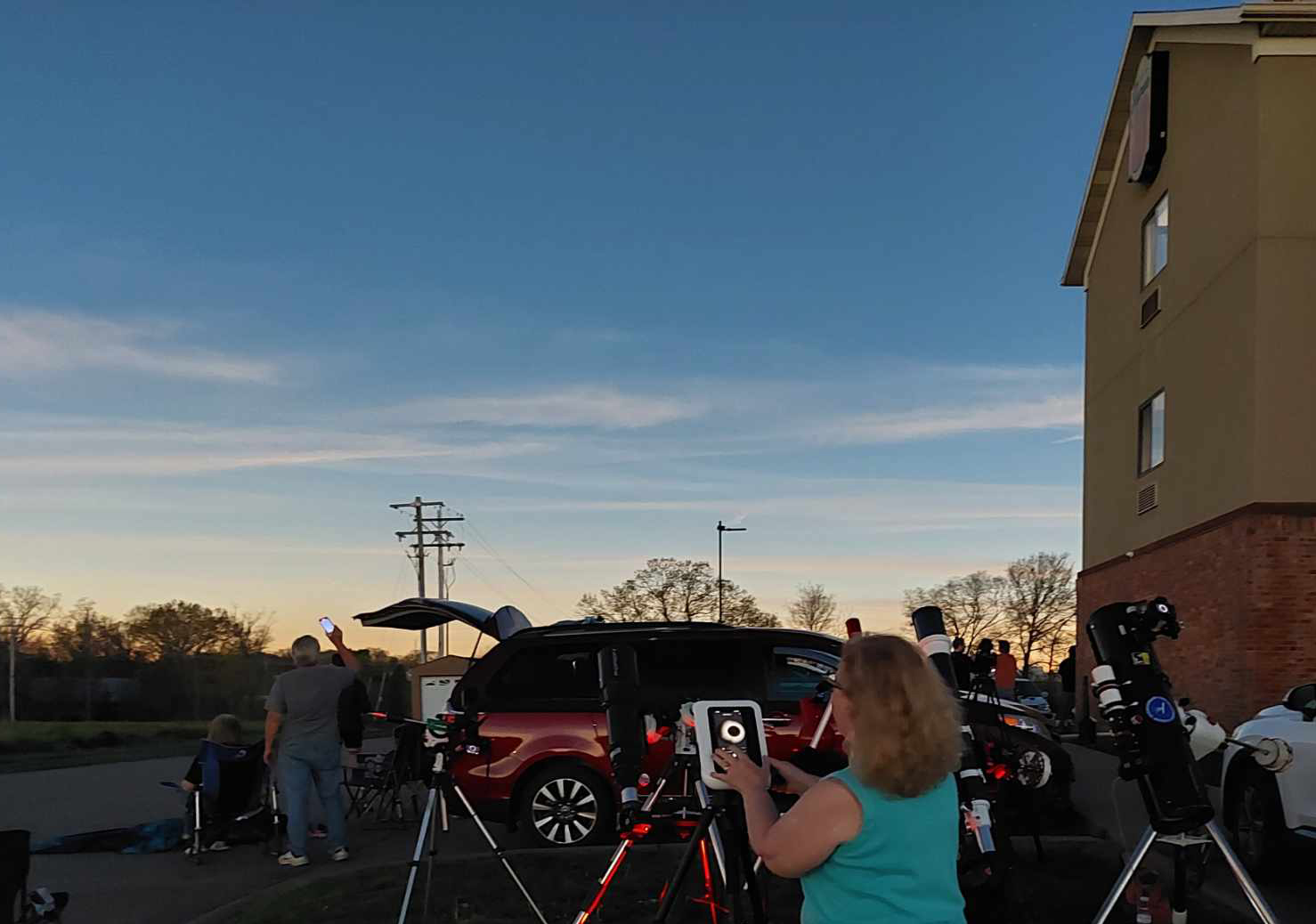
Polly enjoyed operating the Hestia. She encouraaged people to come over and look at a telescopic view of totality by looking at the I-phone. This was a photograph of her during totality operating the instrument.
All the computer operated cameras worked correctly. As it turned out, the mass of telescopes and cameras overloaded me. I had difficulty making sure everything was correct on all of them. Once again, focus was an issue on two telescopes. The 120mm F5 focus changed at some point and was a complete washout. That scope was just tossed in at the last minute and I had no expected much from it anyway. The 8-inch focus was slightly off again, which prevented me from getting good shots of the prominences. Meanwhile, the focus for the ED80, Zenithstar, and Redcat were very good. The Zenithstar was not precisely centered but it still had good resolution. The 120mm F9 refractor, while in focus, had a black solar filter ring (compared to the silver ones on all the other scopes). When I removed the filter, I failed to notice the black filter on the 120mm in the fading light and failed to remove it. All the photographs on that camera were severely underexposed. The videos on the Astroscan and 400mm were pretty good. I used an electronic eyepiece of the astroscan but it was not tracked. I was only able to video tape the beginning of totality with the diamond ring. The end result of my photographic efforts was, while some of the instruments had problems, the rest gave pretty good results.
Compared to 2017, this was an improvement. We had no cloud interference other than a few wispy cirrus clouds that did not seem to affect anything. I was disappointed with the 8-inch results since I personally operated that camera. I can't believe I did not check the focus more closely. This was a case of instrument overload, where I failed to put my attention towards my primary camera. Despite the focus being slightly off, it still was close enough to show major details of the eclipse. It just did not photograph the prominences clearly. Fortunately, the Zenithstar and ED80 images had excellent focus and recorded the prominences well.
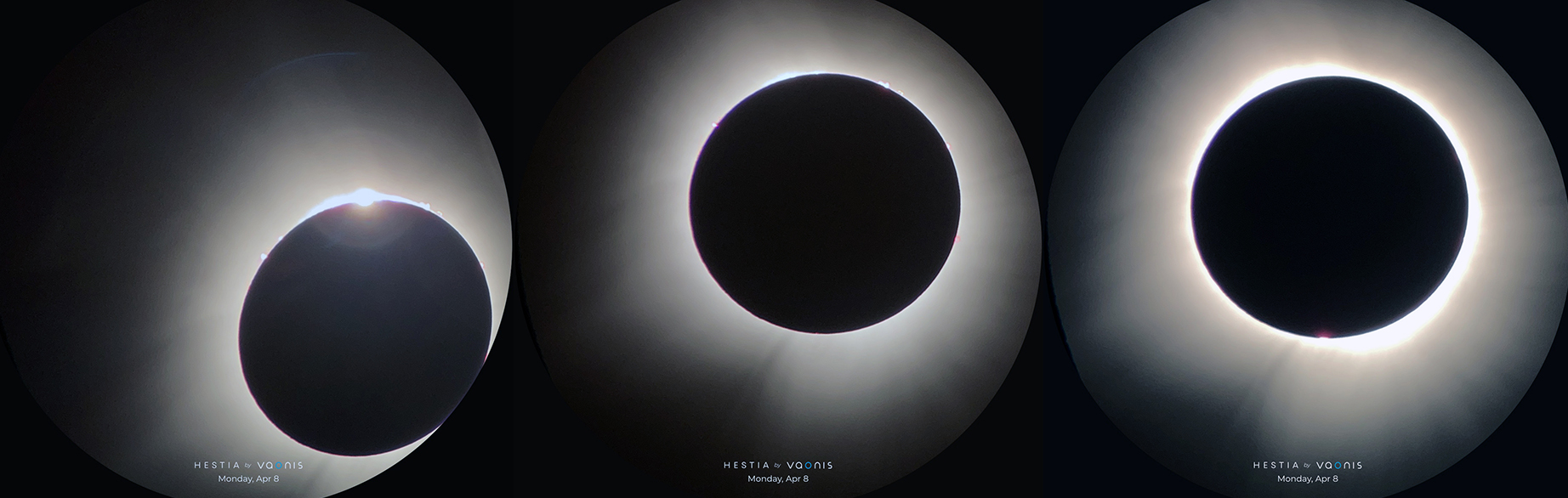
The Hestia got reasonably good results. My wife had problems centering it. It would have been better if the instrument had some slow motion controls that would allow adjustment of the setup.
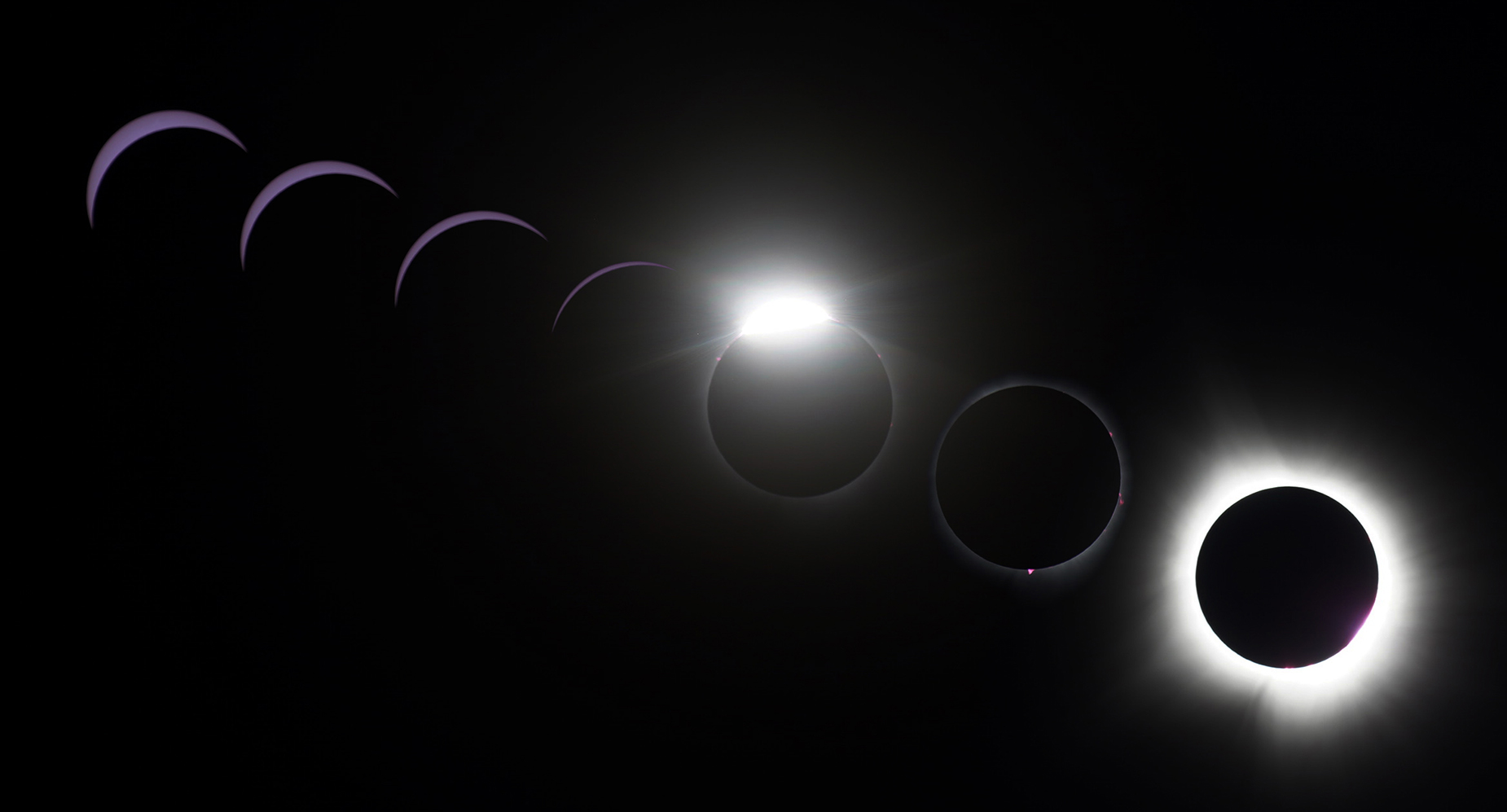
The Redcat got this sequence of images showing the sun just before and during totality. These were taken with a Sony A7 camera at ISO 800.
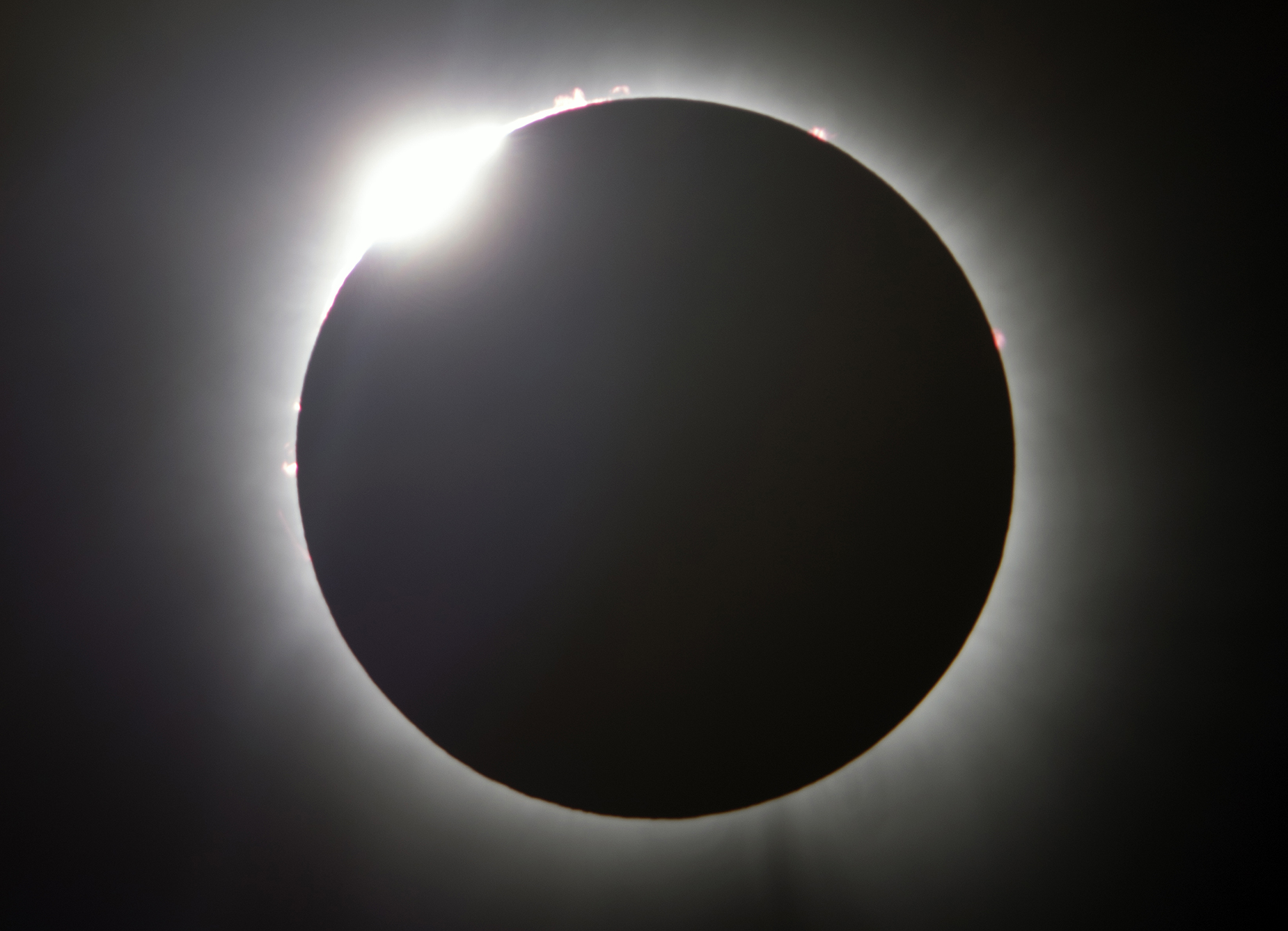
This was the best diamond ring shot. This was with a Canon T6i (ISO 100 1/60 second) and a Zenithstar 61 (2x teleconverter).
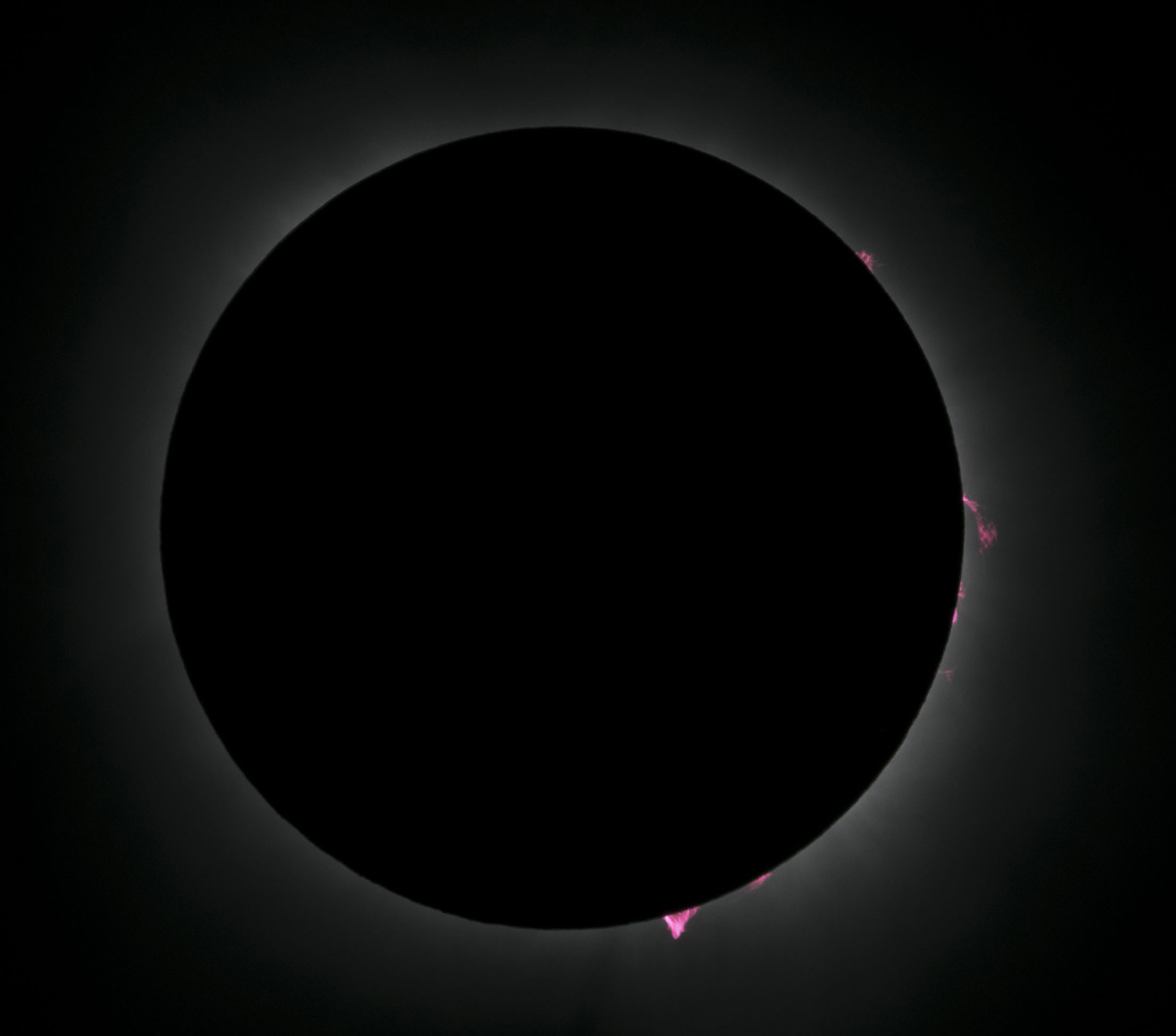
The best prominence photographs were with a Nikon D3300 (ISO 100 1/2000 second) and the ED80 F7 refractor. Focus was perfect and the detail in the prominences were pretty clear.
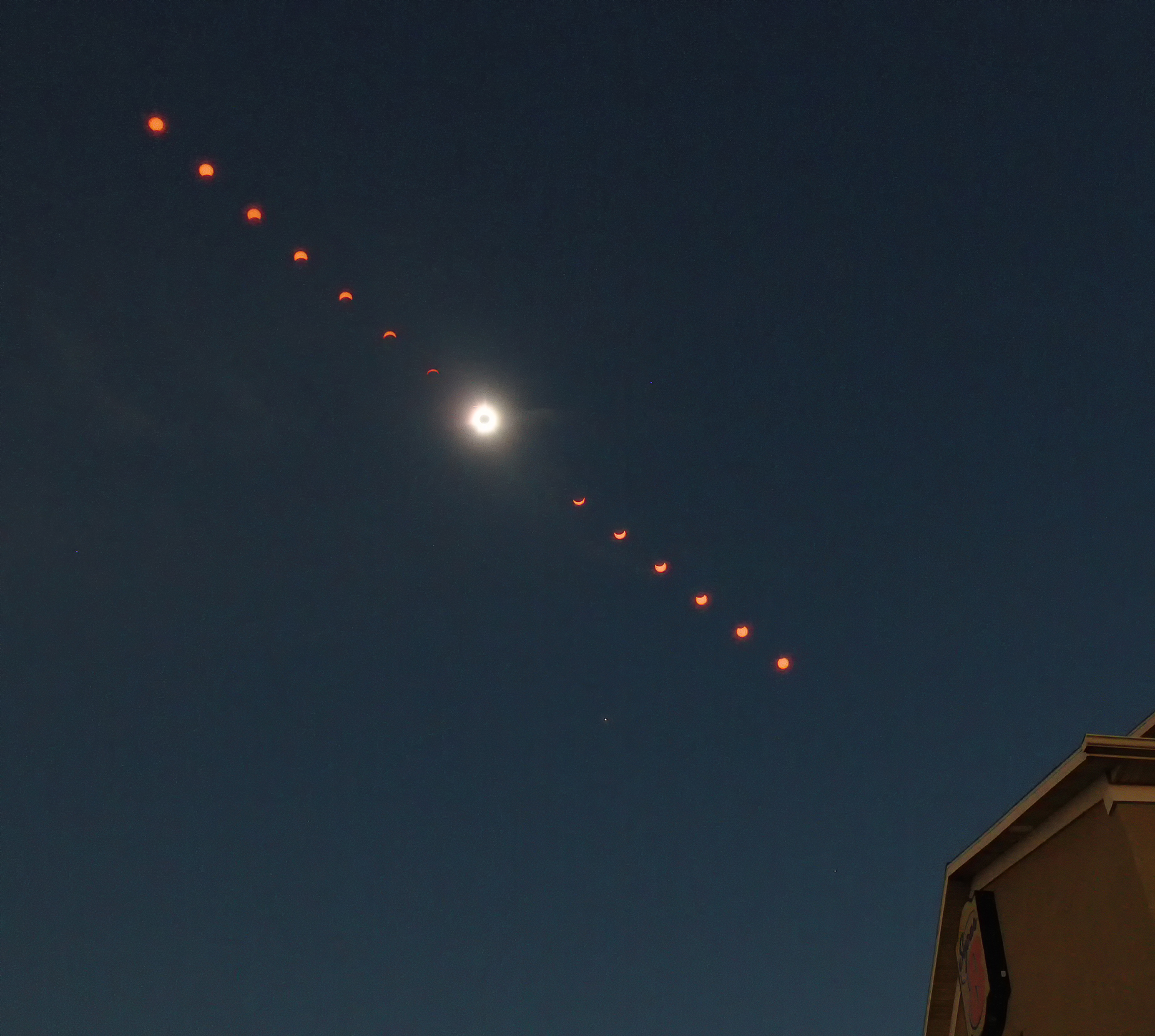
I took this sequence with a Canon T3i and a 14mm lens. While it showed the entire eclipse, the sun was pretty small and I wished I used a longer focal length lens. I also missed an image in the sequence after totality. I was just too busy after totality to get to the camera and take the shot.
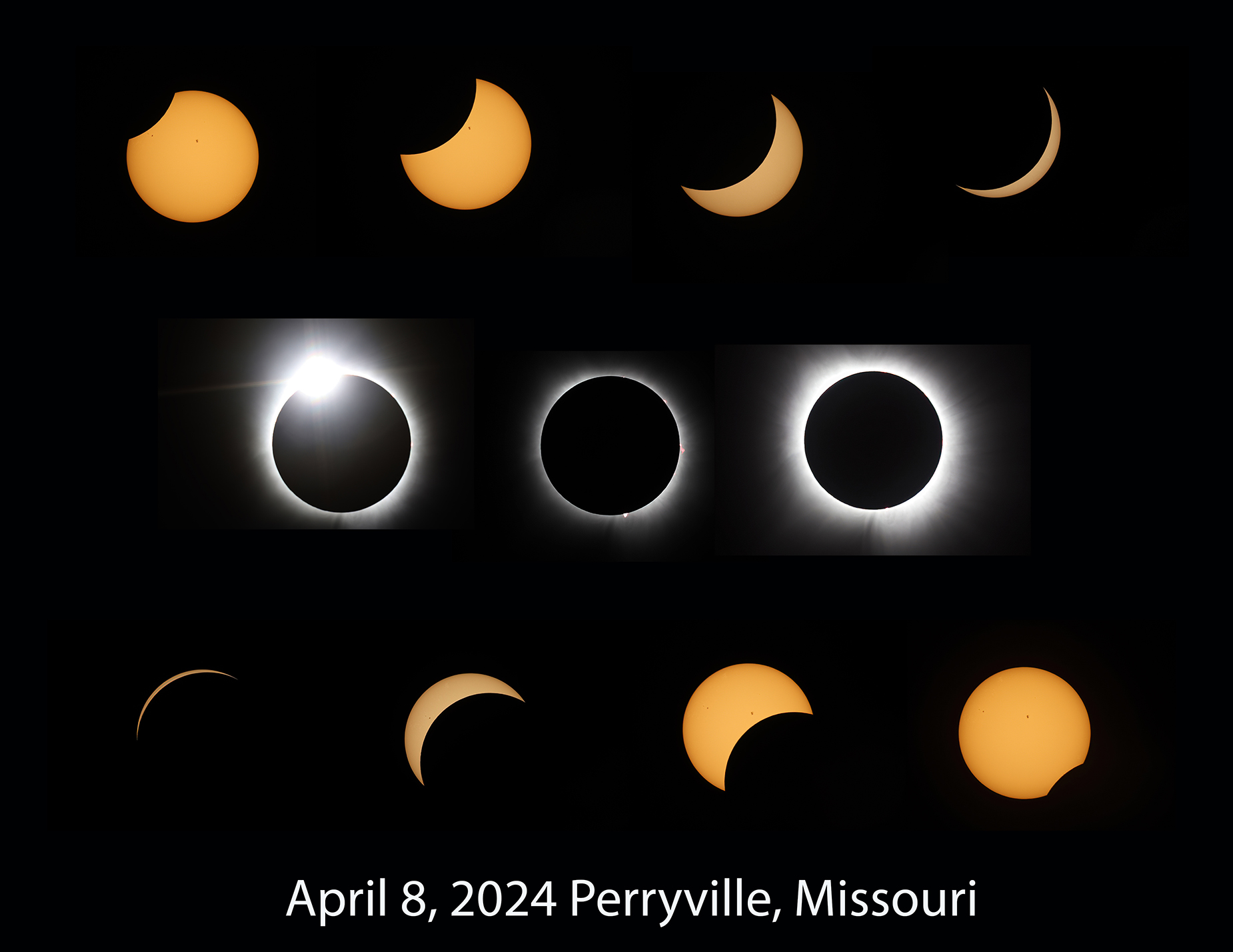
While the 8-inch R100 camera was slightly off focus, the images were not a total loss. This is a mosaic of various phases of the eclipse using that setup.
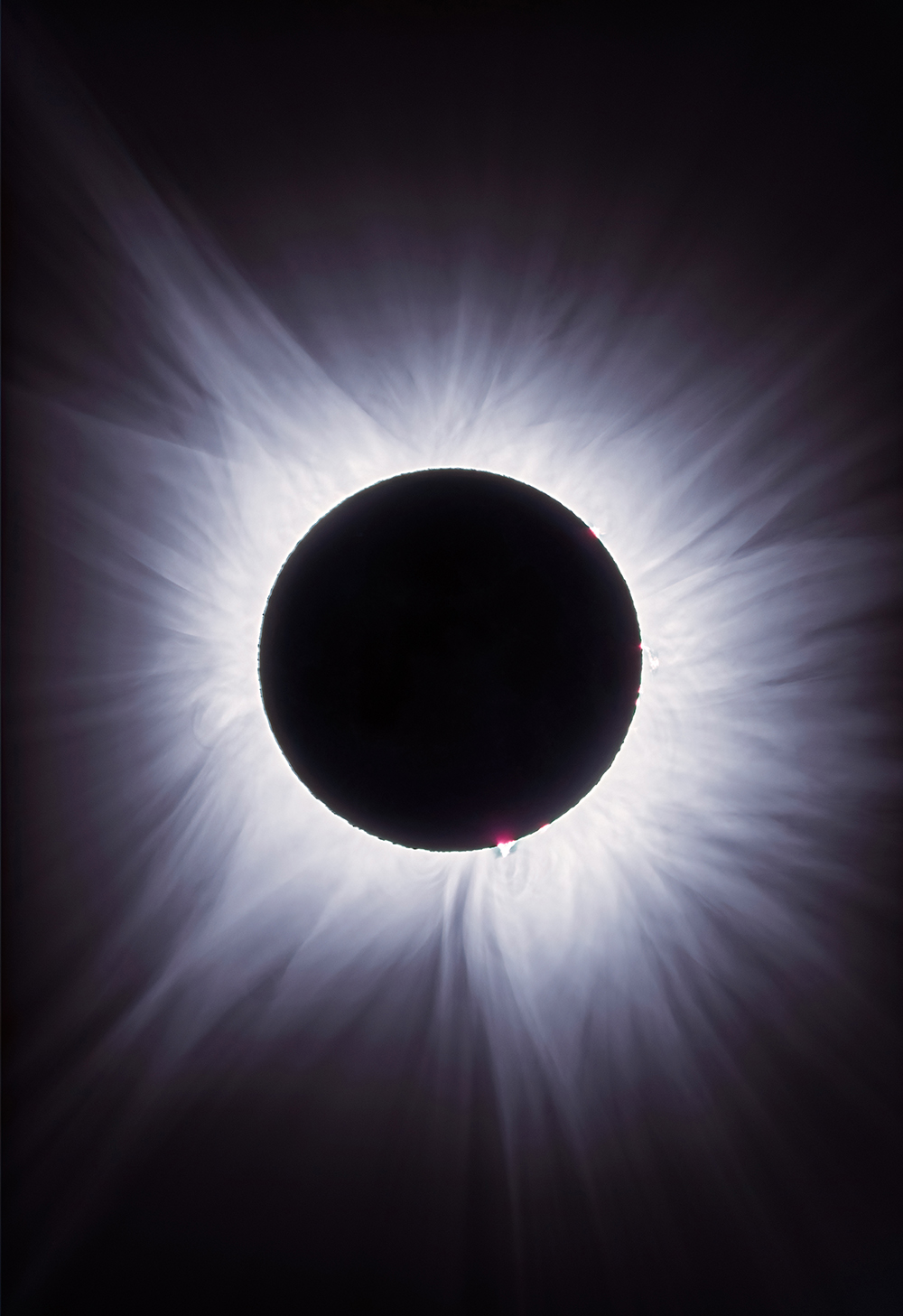
This photograph is a composite of multiple D3300/ED80 totality images showing details in the corona.
Lessons learned