The dance of Jupiter's moons
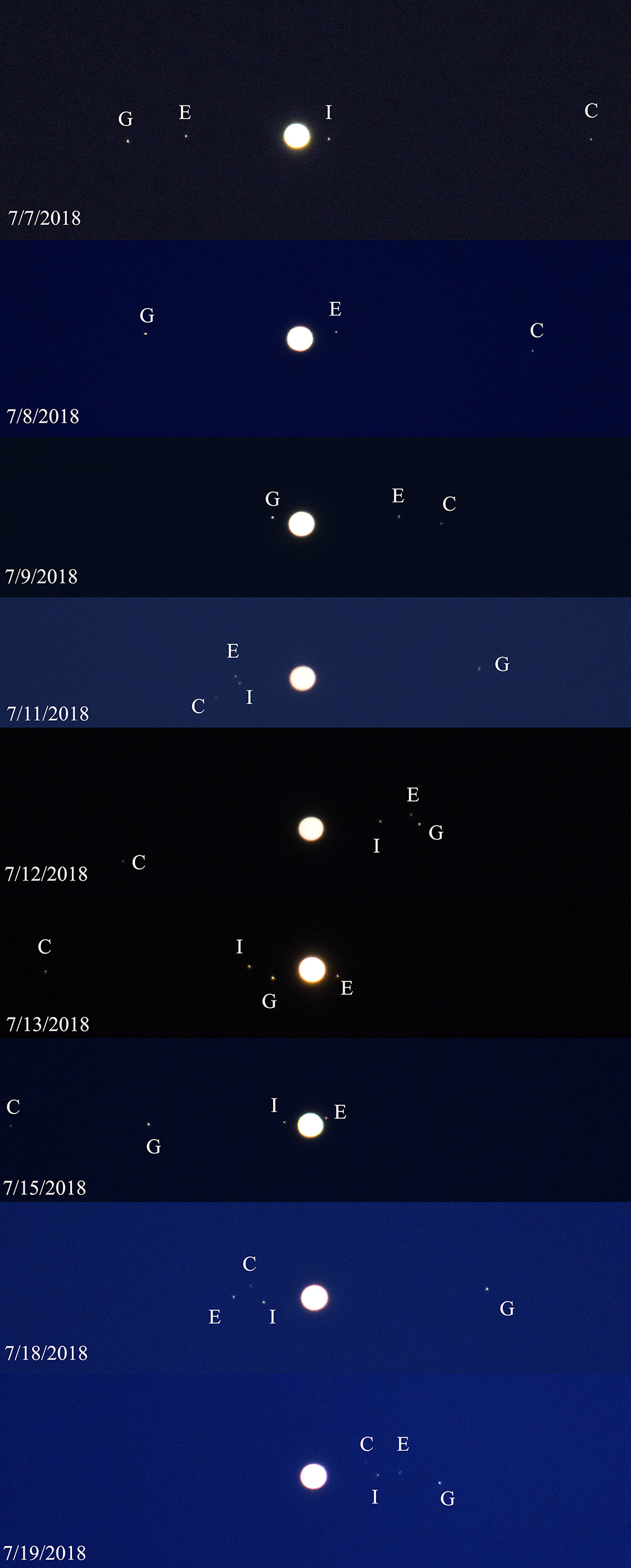
The most interesting aspect for observing Jupiter is watching the features rotate over a few hours and the "dance" that the four Galilean moons exhibit over a few days.
The features on Jupiter's cloud surface are interesting and pretty much consist of the two main equatorial bands and the red spot for visual observation in small telescopes. Jupiter's rotation period is roughly 10 hours, which means that these features will move across the observable face of the planet in just a few hours. In addition to the equatorial belts, one might see other belts. These usually require telescopes of 6-inches or greater as well as good seeing. One might even see blue or brown extensions of the equatorial belts into the lighter cloud banks. These are called "festoons" (I have seen some refer to them as "barges"). These are created by the high wind speeds and mixing of different cloud layers.
In addition to the cloud features, the planet's moons have a unique dance as the orbit the planet. Because they are in the line of sight for earth, they cross in front of and behind the planet regularly. The four moons are:
| Moon | Orbital period |
| Io | 1.76 days |
| Europa | 3.53 days |
| Ganymede | 7.16 days |
| Callisto | 16.69 days |
As the planet's moons orbit, they display several different types of events. The first is the moon will pass in front of the planet. This is called a transit. Shortly before, or after (this depends if it is before after planetary opposition), the transit happens, a dark shadow will appear on the planet's surface. This is the shadow of the moon on the cloud tops of Jupiter. Another event happens when the planet passes through the shadow of Jupiter. This is called an eclipse. The moon will disappear before it passes behind the planet or reappear after it comes from behind the planet. Finally, the moons will sometimes disappear/reappear behind the planet's disc. This is called an occultation. Another type of occultation is when one of the moons passes in front of the other.
This shows the moons dancing around the planet over a period of 12 days. During that time, Callisto almost completes an orbit. All the other moons complete one or more orbits.
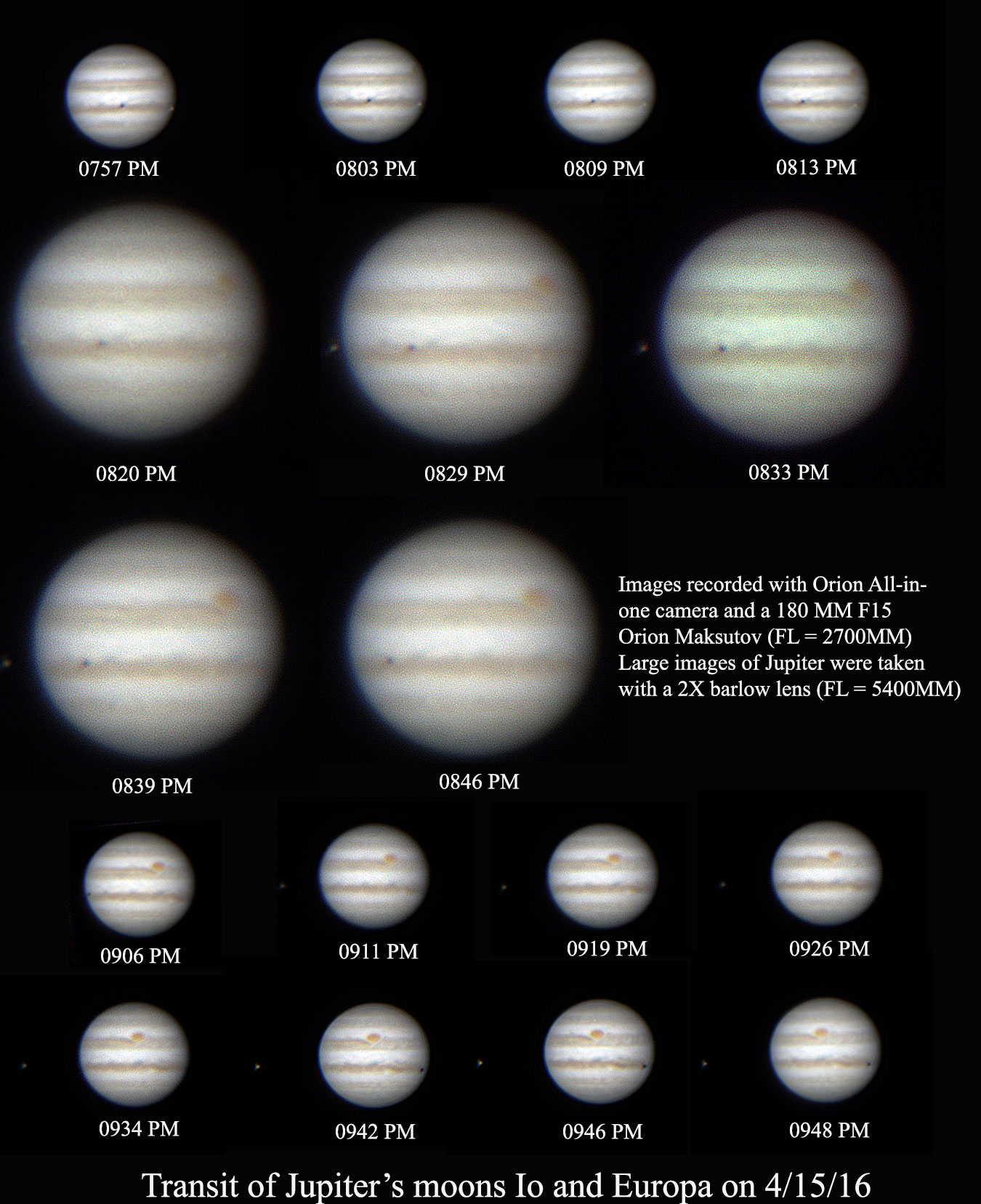
This sequence shows a double transit of Io and Europa. The planet is upside down in this sequence with the moons going right to left. Io can be seen near the left edge of the planet at 8:20 PM as its transit ends. Io's shadow is last seen in the 9:06 PM image. Europa is seen on the right edge of the planet at 7:57 PM and its shadow appears in the 9:42 PM image.
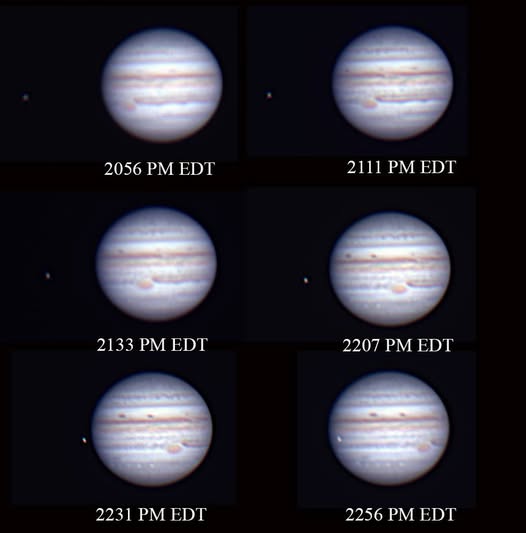
This event happed on September 9, 2021. It shows the red spot as well as multiple features on the planet. The moon Eurpoa can be seen approaching and being to transit across the planet. These images were taken under conditions that had very stable seeing.
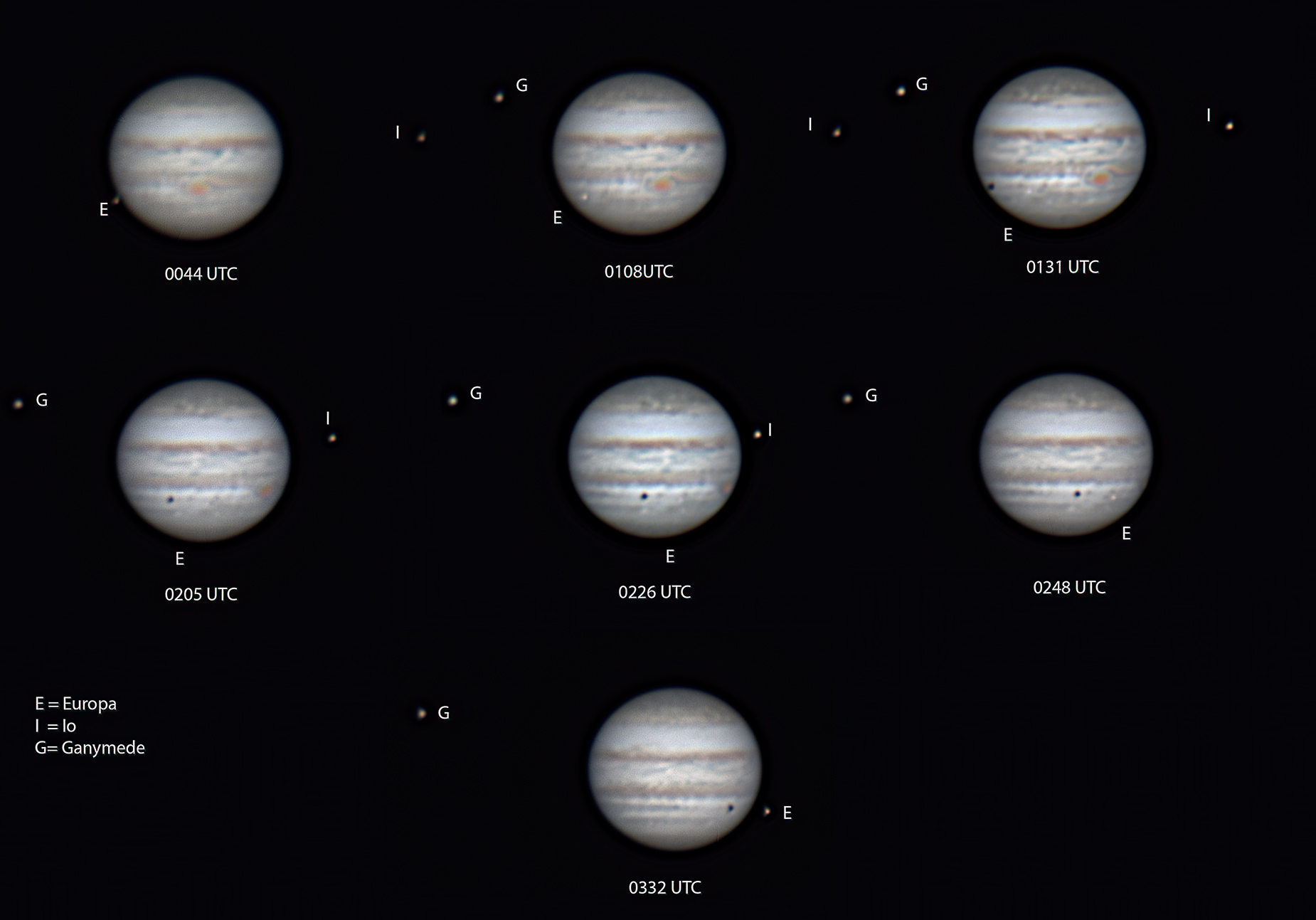
This was a "dance" of three of Jupiter's moons on October 8, 2022. Europa and its shaow are transiting across the planet. Meanwhile, Ganymede reappears from eclipse after coming out of Jupiter's shadow in the 0108UTC image. Io is then occulted by Jupiter after the 0226 UTC image. The red spot is also visible as well as several blue festoons between the two equatorial belts.